
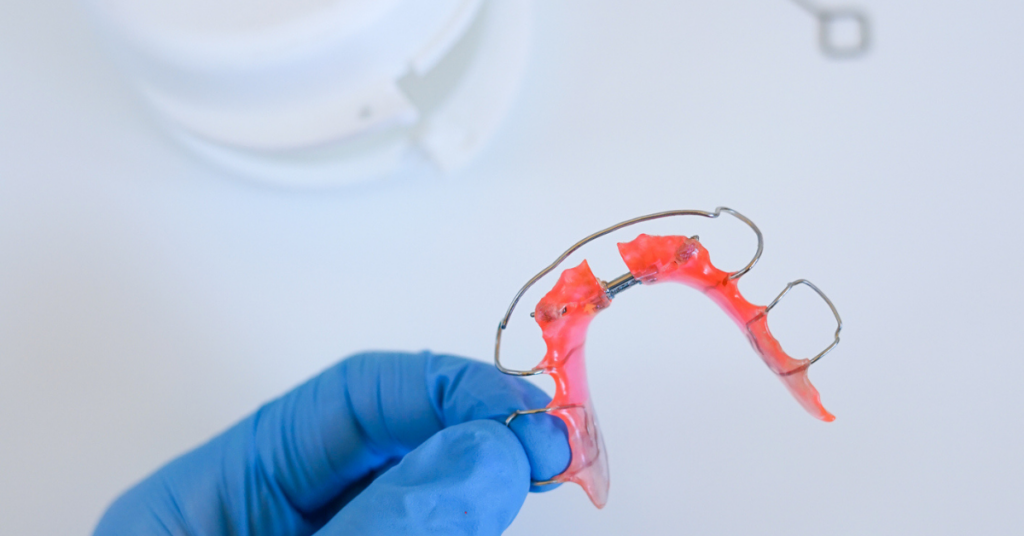
For decades, adults with a narrow upper jaw were told the only option was surgery. If you’re exploring orthodontic care in Encino, Glendale, Pasadena, or elsewhere in the Los Angeles area, here’s the good news: for many adults, that’s no longer true.
The Short Answer
Often, yes. A bone-anchored expander (known as MARPE or MSE) attaches to the palate with small titanium screws instead of relying on the teeth. In many adults into their twenties and thirties, it can gently separate the upper jaw at its midline suture, without a surgical procedure.
Whether it will work for you isn’t really about age. It depends on how fused your palatal suture already is, how thick your palatal bone is, and how much width you actually need. A 3D CBCT scan answers all three before any treatment begins.
Why the old advice was “children only”: Traditional expanders push against the back teeth. In an adult palate, the teeth give way before the bone does, causing tipped molars and gum recession without actually widening the jaw. Bone-anchored expanders solve this by delivering force directly to the palate.
Signs of a Narrow Upper Jaw
- Posterior crossbite (upper back teeth biting inside the lower ones)
- Crowding with a high, narrow, V-shaped palate
- Dark gaps at the corners of your smile (called buccal corridors)
- A bite that shifts sideways to find a fit
- A narrow nasal floor, since the roof of the mouth is also the floor of the nose
What the Scan Decides
Before recommending expansion, we evaluate three things on a CBCT scan, and any one of them can rule it out:
- Suture maturity. Early-stage sutures separate readily. Fully fused ones resist. Miniscrews are especially helpful in the middle ground.
- Palatal bone thickness. The screws need enough bone to anchor safely, away from the nasal floor and tooth roots.
- How much width you actually need. Not every crossbite is skeletal. If the teeth are simply tipped inward, braces or aligners can fix it, and expansion isn’t warranted.
MARPE vs. Surgical Expansion (SARPE)
| Comparison | MARPE / MSE | SARPE |
|---|---|---|
| How It Works | Miniscrews and an expander split the suture with force alone. | A surgeon releases bony resistance first, then an expander finishes the job. |
| Best For | Suture not fully fused, adequate bone, moderate width needs. | Fused suture, very large width needs, failed MARPE, or cases already heading to jaw surgery. |
| Recovery | A few days of soreness for most. | Roughly 1–2 weeks of swelling and soft diet. |
| Cost | Usually included in the orthodontic fee. | Orthodontic fee plus a separate surgical fee. |
MARPE is the less invasive attempt at the same goal, but SARPE remains the right answer when the suture is fused. Choosing it isn’t a failure, it’s the right plan for that case.
What the Process Looks Like
- Planning: CBCT, photos, and scans to map screw placement.
- Placement: The expander and miniscrews are placed with local anesthetic, usually in one visit.
- Activation: You turn a key once or twice daily. Pressure across the nose and cheeks for a few minutes afterward is normal.
- The gap: A space opens between the upper front teeth within about a week, a visible sign the suture has separated. It closes on its own or with light braces mechanics.
- Verification: An early X-ray confirms true skeletal separation. If it hasn’t happened, we stop there.
- Holding: The expander stays in passively for 4–6 months while new bone fills in. Removing it early is the most common cause of relapse.
Risks and Limitations
- The suture may not separate in some adult cases, with odds dropping as age and suture maturity increase
- Screws can loosen, especially in thin bone, though they can usually be repositioned
- Mild soft-tissue irritation around the screws
- Uneven opening between the front and back of the palate
- Relapse if the holding phase is cut short
Expansion treats a specific skeletal problem. When that problem is present, the case for treatment is strong. When it isn’t, the honest recommendation is to leave the palate alone.
Common Questions
What’s the oldest age expansion can work without surgery? There’s no hard cutoff. Successful cases have been reported in patients in their thirties and forties, while some late teens fail to respond. Odds decline meaningfully past the mid-thirties, but a CBCT scan predicts success far better than a birthday does.
Does MARPE hurt? Most patients describe screw placement as pressure rather than pain. Expect firm pressure behind the nose and cheeks for a few minutes after each turn, plus a dull ache the first few days. Over-the-counter pain relief is usually enough.
How long does it take? Active expansion typically takes 2–5 weeks of daily turns, followed by 4–6 months of holding. With braces or aligners alongside, total treatment often lands in the 18–30 month range.
What if the suture doesn’t split? We’d see it on a follow-up X-ray within the first week or two. At that point we stop and discuss surgically assisted expansion or a plan that doesn’t require skeletal width.
Will it change how my face looks? Modestly. It broadens the smile by filling dark corridors at the sides, and some patients see slight widening at the base of the nose. It’s not a facial reconstruction.
Explore Your Options in Encino, Glendale & Pasadena
If you’ve been told you need jaw surgery to widen your upper jaw, or that you’re too old for expansion, a second look with a 3D scan may change the answer. Our orthodontic team serves adults and families throughout Encino, Glendale, Pasadena, and the greater Los Angeles area. Schedule a consultation at the office nearest you to find out whether bone-anchored expansion is right for your smile.